

It is 2026, and the fintech ecosystem in New York’s Financial District operates at a level of speed and complexity that would have seemed extreme only a few years ago. High-frequency trading platforms process millions of transactions in milliseconds. Digital banking platforms must remain available 24/7. Payment infrastructure must comply with increasingly strict financial regulations while handling unpredictable spikes in demand.
For fintech companies in Manhattan and across the greater NYC region, cloud infrastructure is no longer simply about scalability. It has become the operational backbone of trading systems, risk engines, and financial data pipelines.
However, with that opportunity comes a new set of Cloud deployment challenges NYC fintech firms must solve. Latency sensitivity, strict regulatory frameworks like NYDFS cybersecurity rules, and rapidly increasing cloud costs are pushing fintech leaders to rethink their architecture strategies.
The question is no longer whether fintech companies should move to the cloud. The real challenge in 2026 is how to design a cloud architecture that balances speed, compliance, and financial efficiency.
This guide explores what that roadmap looks like.
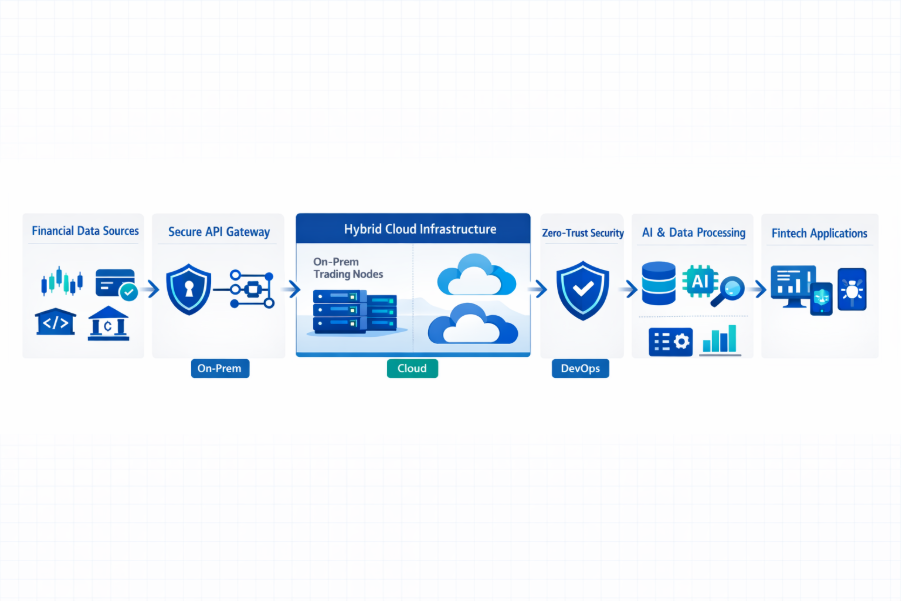
Figure: Modern hybrid cloud infrastructure workflow for fintech platforms, showing secure API ingestion, hybrid cloud deployment, zero-trust security, infrastructure automation, and AI-driven financial applications.
The Cloud Deployment Challenges Facing NYC Fintech
Fintech platforms in New York operate in one of the most demanding technology environments in the world. Trading desks, digital asset platforms, and payment processors must process financial data with near-zero latency.
Three infrastructure challenges dominate the conversation.
1. Ultra-Low Latency Requirements
High-frequency trading platforms operate in microseconds. A few milliseconds of delay can impact trade execution and profitability.
When trading engines run in the cloud, network routing between data centers, exchanges, and cloud regions can introduce unwanted latency. This forces fintech firms to adopt hybrid infrastructure models where certain workloads remain close to financial exchanges.
2. Regulatory Compliance Complexity
NYC fintech companies must meet the NYDFS cybersecurity regulation Part 500, which sets strict standards for financial data protection.
Cloud environments must ensure:
- Encrypted data pipelines
- Identity-based access controls
- Audit logging and traceability
- Continuous security monitoring
Without a strong compliance architecture, even modern cloud deployments can fail regulatory audits.
3. Unpredictable Cloud Costs
As fintech workloads scale, companies encounter a new challenge: data transfer pricing.
Many firms report unexpected cost increases from Overcoming egress fee spikes in AWS/Azure, especially when:
- AI analytics pipelines move large datasets
- Trading data replicates across multiple cloud regions
- Multi-cloud strategies move workloads across vendors
For CTOs and DevOps teams, controlling infrastructure costs is becoming just as critical as building it.
Modern Security: Hybrid Cloud Security and Zero-Trust
Security expectations in fintech have shifted dramatically. Traditional perimeter security models are no longer sufficient.
Instead, financial platforms are now adopting Hybrid cloud security NYDFS Part 500 frameworks that combine on-premise infrastructure with secure cloud environments.
A modern fintech security stack includes:
Identity-first security architecture
Access to systems is controlled through identity verification rather than network location.
Continuous monitoring
Threat detection platforms analyze activity patterns across cloud workloads in real time.
Encrypted infrastructure
All data flows between trading engines, APIs, and analytics systems remain encrypted both in transit and at rest.
This is where Zero-Trust architecture for Wall Street startups becomes essential.
Zero-trust frameworks assume that no user, service, or device should automatically be trusted, even inside internal networks.
Typical implementation steps include:
- Multi-factor authentication for all privileged users
- Micro-segmentation of cloud workloads
- Continuous identity validation for APIs and services
- Automated threat response systems
For fintech startups scaling rapidly in NYC, zero-trust is no longer a security upgrade. It has become the operational baseline.
Operational Efficiency: Multi-Cloud FinOps in 2026
As fintech companies grow, many adopt multi-cloud architectures to avoid vendor lock-in and improve reliability.
However, operating across AWS, Azure, and other cloud providers introduces new cost challenges.
This is where Multi-cloud FinOps strategies 2026 become critical.
FinOps focuses on financial accountability in cloud operations.
Key strategies fintech companies are implementing include:
Real-Time Cost Monitoring
Advanced dashboards track infrastructure spending in real time. DevOps teams can detect anomalies before monthly invoices spike.
Workload Placement Optimization
Certain workloads are cheaper to run in specific cloud providers.
Examples:
- AI workloads in GPU optimized regions
- Data storage in lower-cost archival tiers
- Real-time trading infrastructure in ultra-low latency zones
Data Transfer Optimization
One of the biggest cost drivers is Overcoming egress fee spikes in AWS/Azure.
Solutions include:
- Caching frequently accessed data locally
- Using direct interconnects between cloud regions
- Redesigning analytics pipelines to reduce cross-cloud transfers
For fintech companies processing large volumes of market data, these optimizations can reduce cloud spending by 30 to 40 percent.
Scaling Infrastructure with Terraform and Compliance Frameworks
Cloud infrastructure in fintech cannot rely on manual configuration. Environments must be reproducible, secure, and auditable.
This is where Terraform IaC for high-frequency trading plays a major role.
Infrastructure as Code allows DevOps teams to define cloud environments using version-controlled scripts.
Benefits include:
- Automated infrastructure deployment
- Consistent security configurations
- Rapid disaster recovery
- Full compliance traceability
In high-frequency trading environments, Terraform scripts can automatically deploy:
- Trading engine clusters
- Market data pipelines
- Risk calculation nodes
- Secure database infrastructure
This automation also supports building an Enterprise cloud scalability and compliance framework.
Such frameworks typically include:
Policy-as-code systems
Security and compliance rules automatically apply during infrastructure deployment.
Automated auditing
Every infrastructure change is logged and tracked.
Scalable architecture design
Microservices and container orchestration enable systems to scale dynamically during trading spikes.
The result is an infrastructure stack that can expand during peak market activity without compromising security or compliance.
Future-Proofing Fintech Platforms with AI-Ready Infrastructure
The next frontier of fintech innovation is AI-driven financial platforms.
From fraud detection to algorithmic trading models, AI workloads require specialized cloud infrastructure.
That is why many fintech firms are now Building AI-ready cloud infrastructure for SaaS platforms.
An AI-ready architecture typically includes:
- GPU optimized compute clusters
- Real-time data streaming pipelines
- Distributed data lakes
- Machine learning model deployment pipelines
For SaaS-based fintech platforms, this infrastructure supports:
- Fraud detection models analyzing transactions in milliseconds
- Credit risk prediction engines
- AI-driven trading signals
- Customer financial insights platforms
In 2026, fintech leaders are not simply building scalable cloud systems. They are building AI-native financial platforms.
Case Study: A NYC Fintech Optimizing Its Cloud Stack
Consider a mid-sized digital payments firm based near Wall Street.
The company processes over 15 million payment transactions daily and operates in both US and international markets.
Initial cloud architecture relied heavily on a single cloud provider.
Challenges included:
- High data transfer costs between analytics pipelines
- Latency issues in payment verification systems
- Increasing compliance complexity under NYDFS cybersecurity requirements
The company redesigned its infrastructure using the following approach:
- Hybrid architecture connecting on-prem trading nodes with cloud services
- Terraform-based infrastructure automation
- Zero-trust identity security across APIs and internal services
- Multi-cloud cost optimization strategies
Within one year, the company achieved:
- 42 percent reduction in infrastructure costs
- 30 percent faster payment verification processing
- Full compliance with NYDFS cybersecurity standards
The lesson is clear. Cloud architecture decisions directly impact fintech performance and profitability.
Frequently Asked Questions
What are the biggest cloud deployment challenges NYC fintech firms face today?
The main challenges include latency-sensitive trading workloads, strict regulatory compliance requirements such as NYDFS Part 500, and increasing cloud infrastructure costs driven by large financial data transfers.
Why is hybrid cloud architecture common in fintech?
Hybrid architectures allow firms to keep latency-sensitive systems like trading engines close to exchanges while running analytics, AI models, and SaaS platforms in scalable cloud environments.
What role does FinOps play in fintech cloud infrastructure?
FinOps helps fintech companies manage cloud spending by tracking infrastructure usage, optimizing workload placement, and reducing unnecessary data transfer costs across cloud providers.
How does Terraform improve fintech cloud environments?
Terraform enables infrastructure as code, allowing teams to automate cloud deployments, maintain consistent security policies, and quickly rebuild environments in case of outages or cyber incidents.
Why are fintech platforms building AI-ready infrastructure?
AI technologies are becoming central to fraud detection, trading algorithms, and financial risk analysis. AI-ready infrastructure ensures fintech platforms can process large financial datasets efficiently.
Conclusion
The fintech ecosystem in New York continues to evolve at extraordinary speed. Cloud infrastructure is no longer just an operational layer. It is the foundation for secure trading platforms, scalable financial services, and AI-powered innovation.
Fintech firms that successfully address Cloud deployment challenges NYC fintech environments present will gain a clear competitive advantage.
By implementing hybrid security aligned with NYDFS standards, adopting Multi-cloud FinOps strategies 2026, automating infrastructure with Terraform, and designing AI-ready platforms, financial institutions can build resilient technology foundations for the future.
Organizations looking to accelerate this transformation often partner with an AI development company in New York that understands financial technology ecosystems.
With deep expertise in web, mobile and cloud engineering, Theta Technolabs helps fintech companies design secure, scalable, and AI-ready infrastructure built for modern financial platforms.
Strengthen Your Fintech Cloud Foundation
If your fintech platform is preparing for the next generation of cloud infrastructure, the right architecture strategy can significantly improve scalability, security, and operational efficiency.
Theta Technolabs provides consulting and development expertise across Web, Mobile and Cloud platforms, helping fintech organizations implement advanced cloud architectures and AI-driven financial systems.
For a strategic consultation on your fintech cloud infrastructure roadmap, contact: sales@thetatechnolabs.com


































.png)





.png)


























.png)

























.png)