Picture a procurement call where a Los Angeles building operator is comparing two industrial AC units. Both cool the space well. One arrives with a live dashboard, failure alerts, and an energy report. The other ships as capable but silent hardware. The connected unit wins, and its maker now has a customer relationship that lasts years instead of a single transaction. For many HVAC manufacturers in Los Angeles, that gap is the difference between commanding a premium and competing on price. Building IoT-enabled HVAC products is how equipment makers close that gap. This guide walks through what the shift involves, how to approach the build, and how to start without rebuilding your company around it.
Why Los Angeles HVAC manufacturers are rethinking the one-time sale
For decades the model was simple. Design a reliable unit, sell it through your dealers, move on to the next order. That model is under pressure. Cooling systems and industrial AC have become harder to differentiate on specification alone, and when products look interchangeable, buyers decide on price. Connecting the product changes that. A connected unit keeps making money after it is installed, which a one-time sale never does.
Three streams tend to matter most for equipment makers:
- Monitoring subscriptions that give customers visibility into their own systems
- Predictive maintenance plans that turn service from a cost into a recurring contract
- Dashboard and reporting access that customers will pay to keep
There is a relationship benefit too. Once a building runs on your connected platform, switching to a competitor means giving up history, alerts, and reporting, so customers stay. This is the same move toward connected products and manufacturing software solutions reshaping industrial equipment more broadly, where the software and data around a machine can matter as much as the machine.
What IoT-enabling your HVAC products actually means
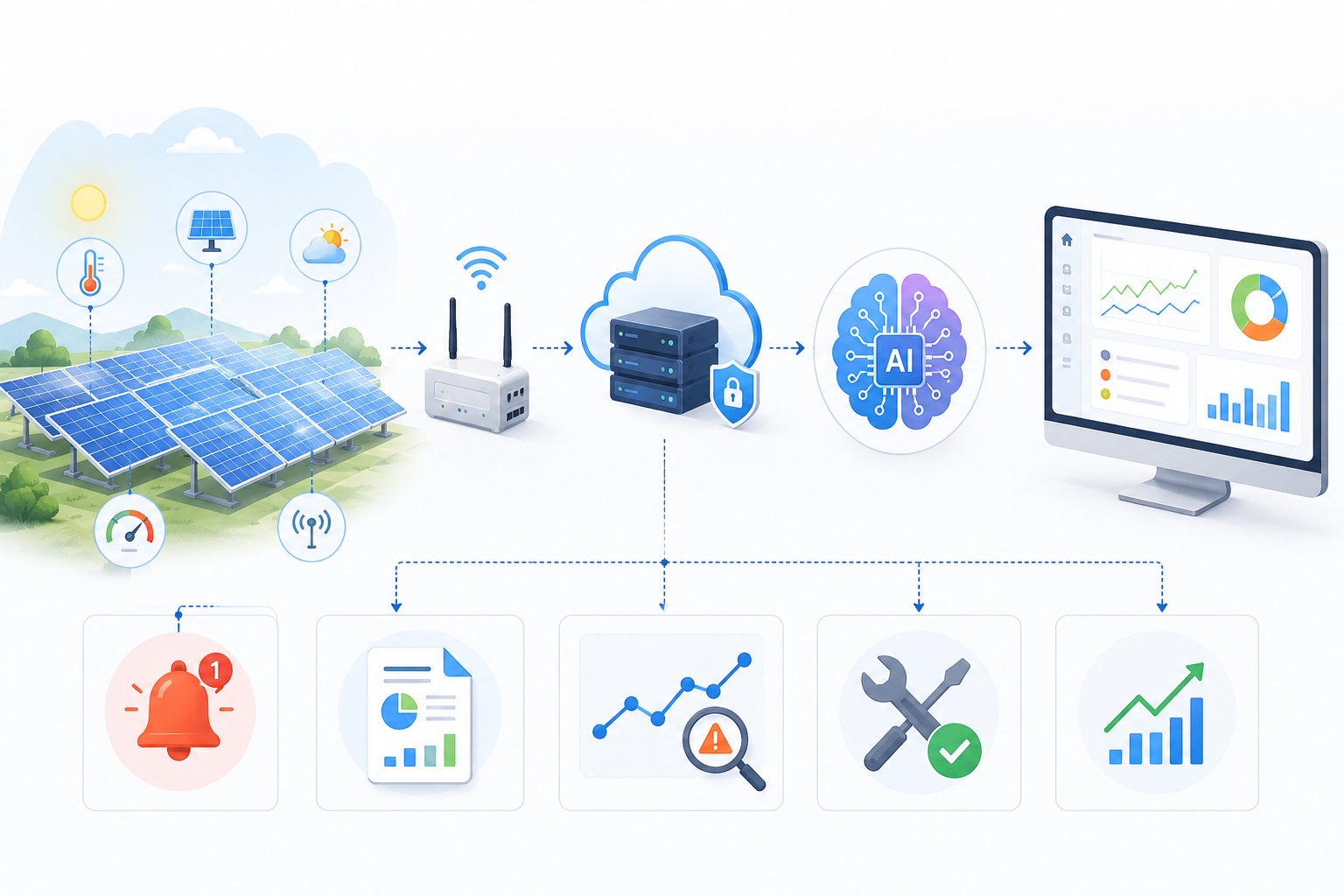
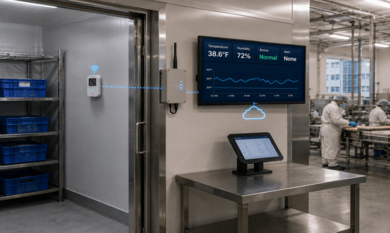
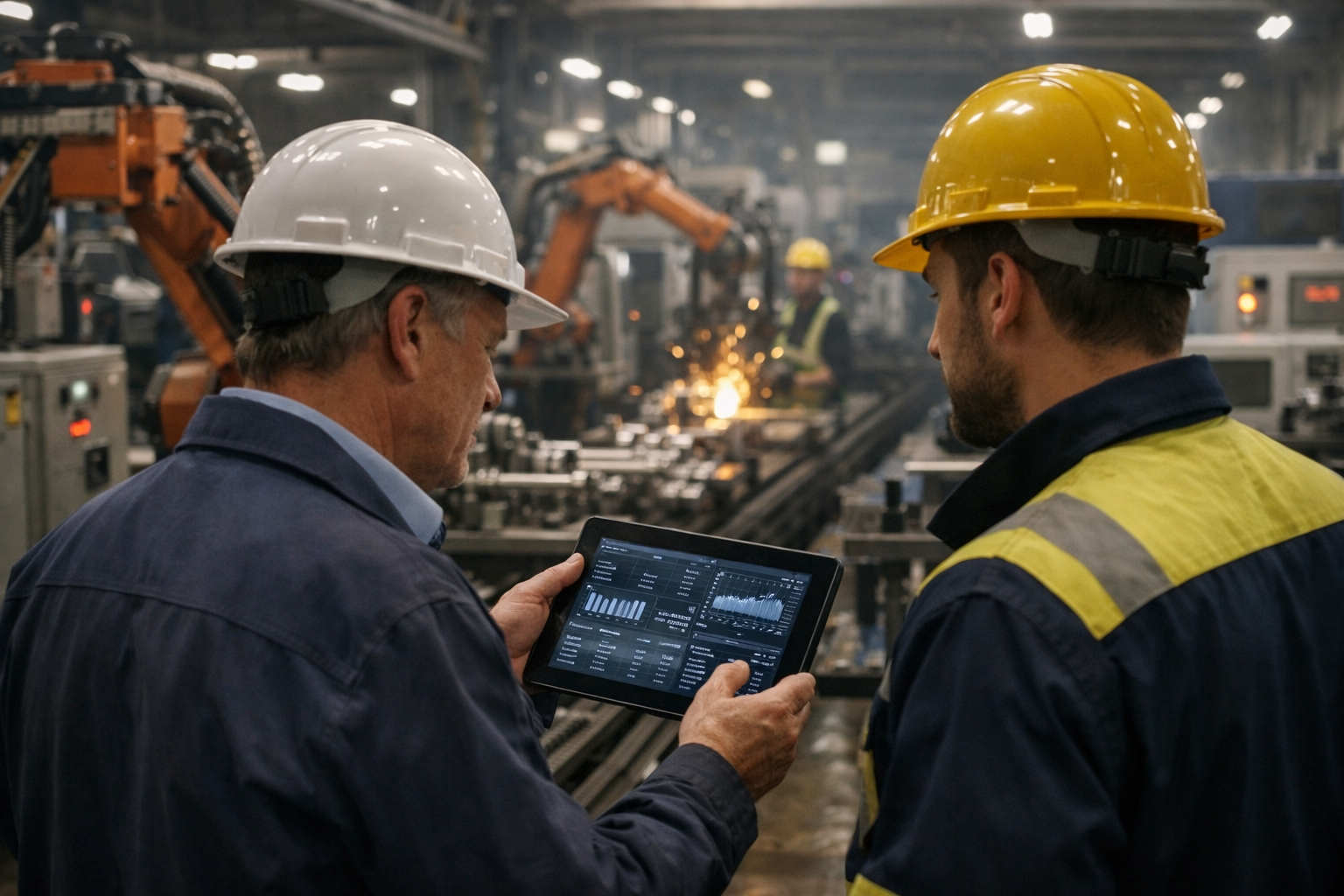
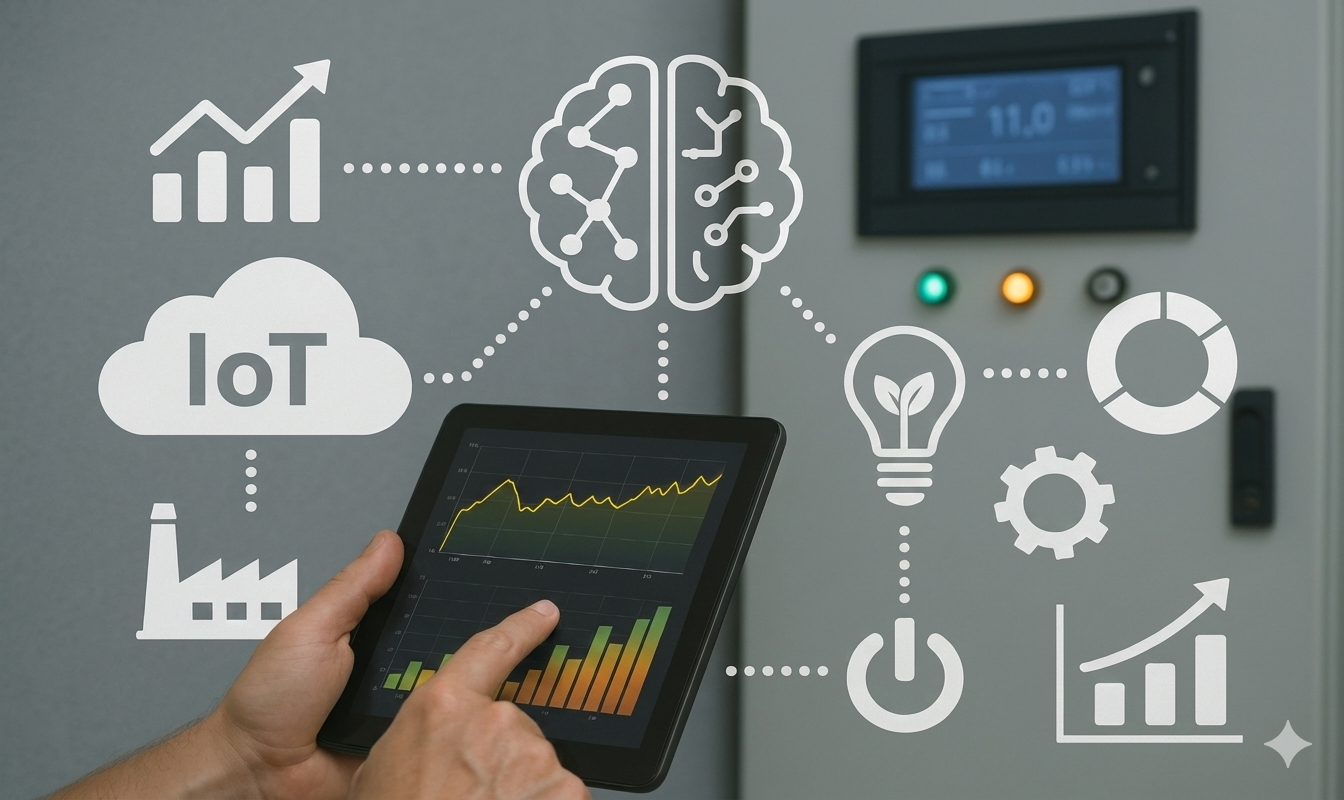
At its core, an IoT-enabled HVAC product is equipment that senses its own operation, sends that data off the unit, and turns it into something useful. Sensors capture conditions like temperature, pressure, current draw, and runtime. A connectivity layer moves those readings to the cloud. Software then converts raw data into smart HVAC monitoring, alerts, energy reports, and a view of how the equipment is actually performing in the field.
It helps to separate connected from smart. A connected unit reports data. A smart unit acts on it, flagging an abnormal pattern before a failure or nudging settings toward lower energy use. For the customer, the visible result is simple. Instead of waiting for a breakdown, they see a dashboard, get an alert when something drifts, and trust that the equipment is watching itself. For the manufacturer, it is a feature rivals without it simply do not have.
How to add IoT to HVAC equipment
Knowing how to add IoT to HVAC equipment comes down to four layers working together. None of it is complicated, but the choices in each layer affect your cost, your reliability, and how fast you launch.
Sensors and the data they capture
Start with what you want to know. Temperature, pressure, amperage, vibration, and runtime hours each tell a different story about a unit's health and efficiency. The sensors you choose, and where you place them, determine which insights you can offer later. It is cheaper to plan this once than to revisit it after launch.
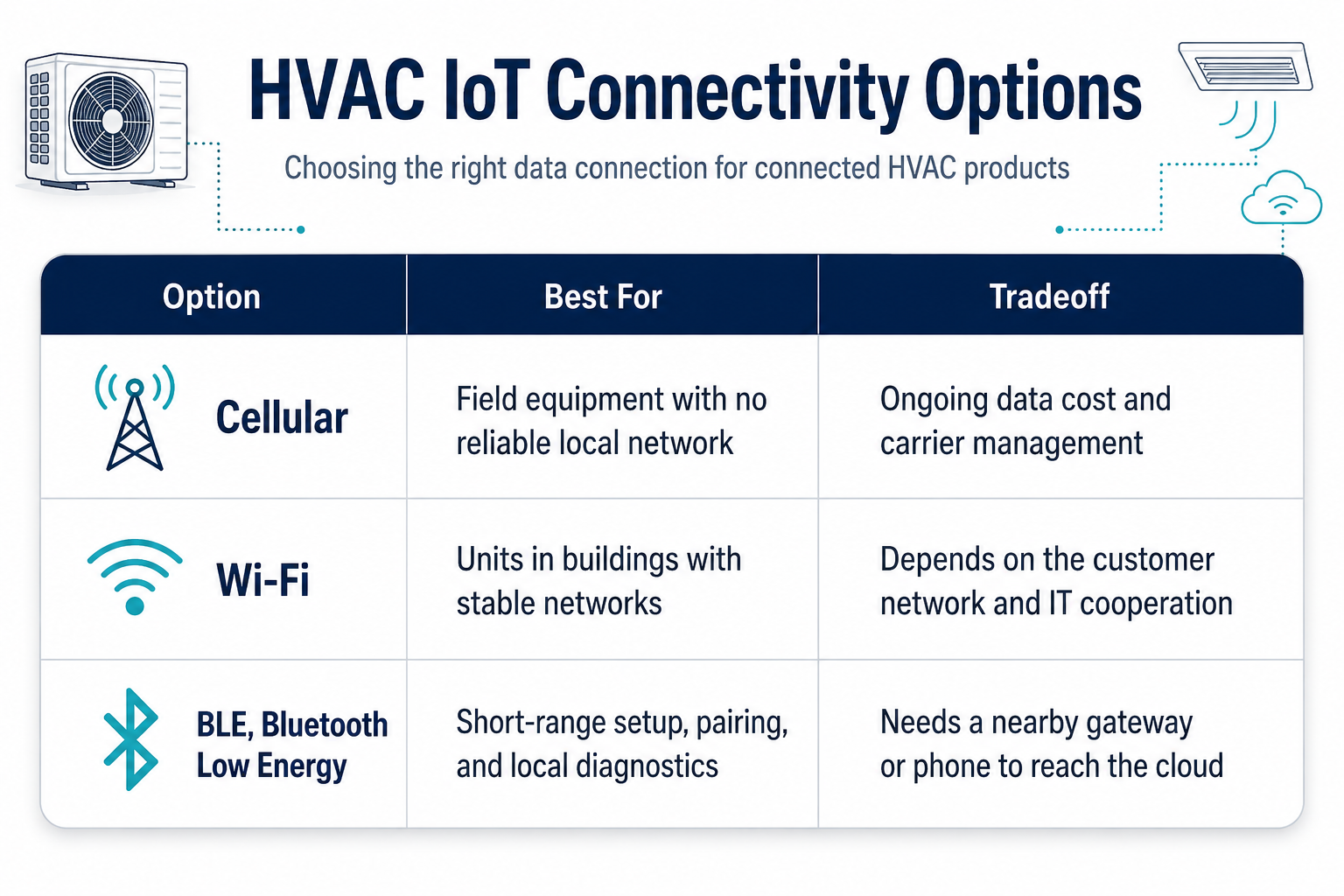
Connectivity options
Next, decide how data leaves the unit. The right choice depends on where your equipment lives.
Cloud, dashboard, and firmware updates
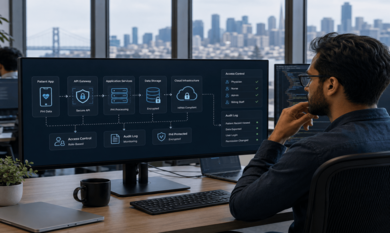
Finally, data needs a home. A cloud layer stores and analyzes readings, a dashboard presents them to the customer, and over-the-air updates (software improvements sent to the unit remotely, with no site visit) let you improve the product after it ships. That last point matters. Connected equipment can get better in the field, which is something traditional hardware never could.
Retrofit or built-in, which path fits your product line
One decision shapes everything else. Do you retrofit IoT onto products you already make, or build it into the next generation? Both are valid, and the right answer depends on your catalog and your installed base.
An IoT retrofit for HVAC products adds a module to existing units. It reaches equipment already in the field, gets you to market faster, and lets you monetize an installed base quickly. The tradeoff is that an add-on rarely integrates as cleanly as native hardware, and per-unit economics are tighter. Building IoT in from the design stage gives you tighter integration, better margins over time, and a cleaner customer experience, at the cost of a longer road tied to a new product cycle.
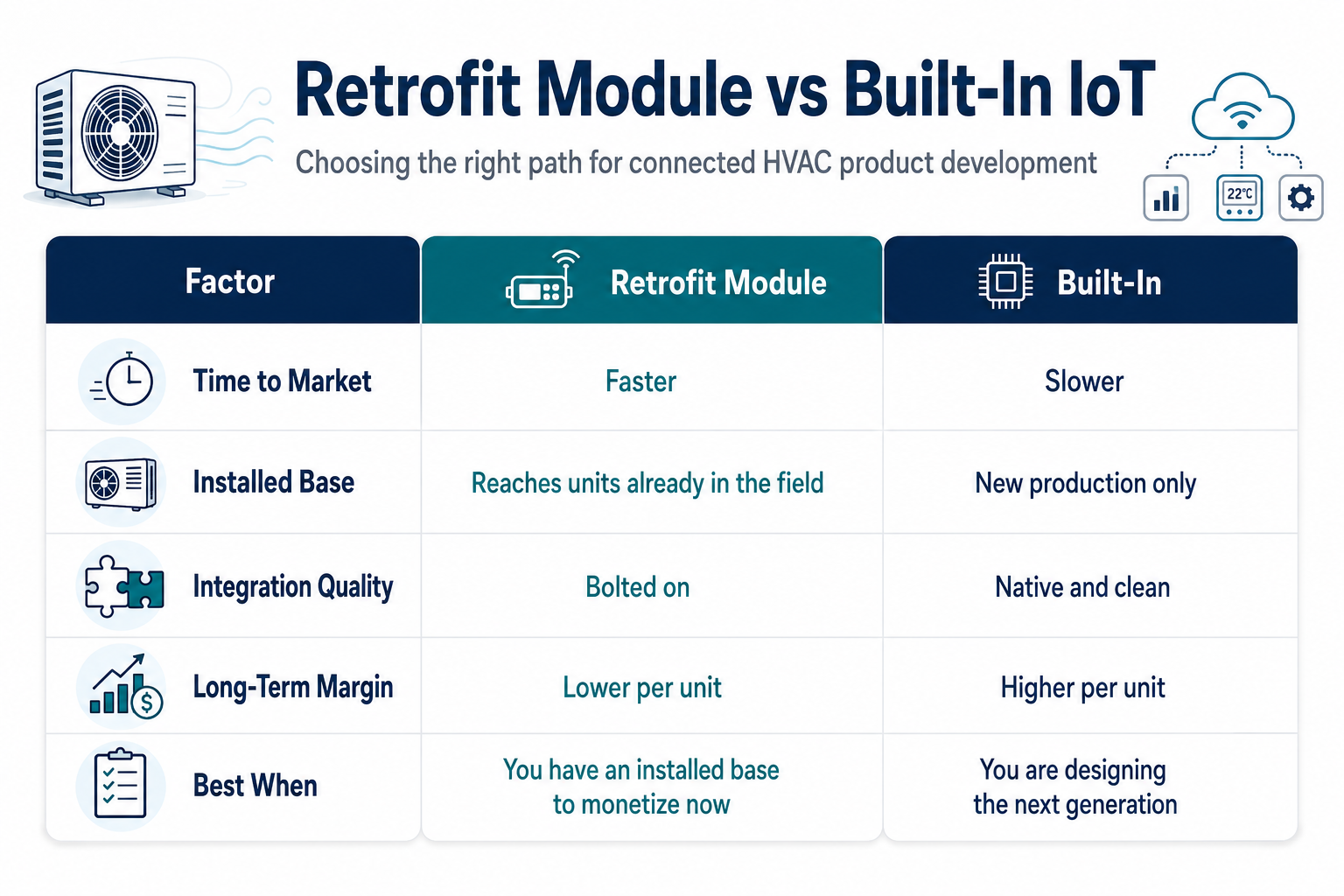
A simple way to decide is this. If you have a large installed base to serve now, start with a retrofit and learn from it. If your strongest opportunity is the next model, design connectivity in from the start. Many manufacturers do both, adding modules to learn while building the lessons into what comes next.
Smart monitoring and energy optimization for California's energy rules
The two connected features that pay off fastest are predictive maintenance for HVAC and HVAC energy optimization. Predictive maintenance uses live data to catch wear before it becomes a failure, which means fewer emergency service calls and less downtime for your customer. Energy optimization uses the same data to keep equipment running efficiently rather than drifting out of its best operating range.
In Los Angeles, the energy angle carries extra weight. California regulates building energy performance tightly through the California Energy Commission, whose Building Energy Efficiency Standards under Title 24, Part 6 are updated every three years. The 2025 edition took effect on January 1, 2026, and the code calls for HVAC systems to be verified against their design performance, not just installed and forgotten. That pressure flows to your customers, the building owners and operators who have to meet it. Equipment that can prove and improve its own energy performance is easier for them to specify and keep.
This is where the data starts to pay off. Turning sensor streams into AI-driven IoT analytics gives customers the efficiency reporting and early warnings they increasingly expect, and gives buyers a reason to pick your equipment.
Protecting your dealer relationships and owning your platform
Two worries tend to hold manufacturers back. Both have a simple answer.
The first is channel conflict. If your dealers and distributors have always handled installation and service, a direct monitoring offering can feel like you are competing with them. The fix is not to bypass them but to equip them. Give dealers the dashboards and alerts so they deliver faster, smarter service, and share the value the connected platform creates. Handled this way, connectivity strengthens the channel instead of threatening it.
The second is ownership. When you connect a product, you generate valuable data, and it matters whether that data and the platform belong to you or to a vendor you rent from. A manufacturer-owned platform keeps the customer relationship, the brand, and the data under your control. Building on someone else's platform can be faster to start, but it can also mean handing over the very asset that makes connectivity worthwhile. For most manufacturers planning a long-term business on connected equipment, owning the platform is the stronger position.
How to start your IoT product transformation
You do not need to transform your entire product line at once. The lowest-risk path is to start small and prove the case before you scale.
- Pick one product. Choose a single unit with a clear customer need for monitoring or efficiency, and a healthy sales volume.
- Run a connected pilot. Add sensors and connectivity, get real units reporting data, and watch how customers use it.
- Prove the business case. Measure what the pilot delivers, from fewer service calls to better energy reporting to early interest in subscriptions.
- Scale across the line. Take what worked and roll it into more products, and into your next designs.
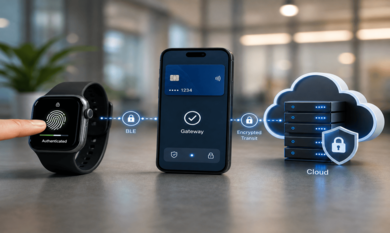
The piece that stops many manufacturers is capability. A connected product pulls together a full stack, embedded firmware (the software built into the device) and sensors on the unit, BLE or cellular connectivity, MQTT telemetry (a lightweight way to stream device data to the cloud), an edge and cloud layer (edge meaning data is handled on or near the unit before it reaches the cloud), real-time dashboards, over-the-air updates, and the predictive analytics that turn raw data into monitoring and energy insight. Few equipment makers want to build a team for all of that in-house. This is where an IoT development and consulting partner fits. At Theta Technolabs, we handle those technical layers so your IoT product transformation moves at the speed of your business rather than your hiring. To scope a pilot or talk through your product line, reach the team at sales@thetatechnolabs.com.
Frequently asked questions
1. How much does it cost to add IoT to an existing HVAC product?
There is no single number, because cost depends on whether you retrofit or build in, how many sensors you need, and which connectivity you choose. The practical move is to scope a single-product pilot first, which gives you a real budget basis before committing across the line.
2. Should I retrofit my current units or build IoT into the next model?
If you have a large installed base you want to monetize soon, retrofit. If your best opportunity is the next product generation, design it in. Many manufacturers add a module to existing units to learn, then build those lessons into new designs.
3. Will offering remote monitoring upset my distributors?
Only if it bypasses them. Give dealers access to the monitoring tools so they deliver better service, and connectivity becomes something that helps the channel rather than competing with it.
4. Who owns the data from connected HVAC equipment?
That depends on how you build. A manufacturer-owned platform keeps the data and the customer relationship with you, which is why platform ownership is worth deciding early.
5. Do I need an in-house IoT team to do this?
No. A product transformation partner can cover the embedded, software, and cloud work, so you can launch connected products without building a full IoT team yourself.
Closing thought
More and more, HVAC makers fall into two camps, those who sell hardware and those who sell connected products. In Los Angeles, the second camp is pulling ahead. And the steps are simple enough to start now. Decide between retrofit and built-in, start with one focused pilot, and keep your platform and data your own. Manufacturers who build IoT-enabled HVAC products now will keep the customers that everyone else still loses the moment a unit is sold.


















.png)



.png)





















.png)




















.png)


.png)



.png)