

Finance teams often discover a mismatch long after the original transaction was processed. A settlement appears in the bank feed, but the amount differs from the payment platform's report. Someone investigates fees, refunds, timing differences and missing references before deciding whether the records can be closed. Automating the search is useful. Allowing software to change financial records without control is a different matter.
Agentic AI for finance operations can assist with reconciliation by gathering permitted records, comparing evidence and preparing exceptions for review. The important design choice is to separate information gathering and recommendations from posting adjustments, approving write-offs or moving money. This article explains how a New York finance team can build that separation into a practical workflow.
Start with the transaction, not the AI agent
A reliable financial reconciliation automation process begins by defining what should match. For example, an order ledger records a gross payment, the processor reports its fee and net payout, and the bank shows the deposited amount. Differences may be legitimate because of settlement cutoffs, partial refunds, foreign exchange or chargebacks. Other differences are caused by duplicate files, missing IDs or incorrect bookkeeping.
A software agent should not decide that two values match simply because their amounts look close. The system needs an explicit matching policy: accepted identifiers, expected fees, currency treatment, accounting period and tolerance rules. Where transaction identifiers are missing, the agent can suggest a possible relationship, but it should label the evidence and confidence clearly.
Payment firms, lenders and finance departments need to fit this workflow to their existing authorization controls.
Give each agent a narrow responsibility
A useful design separates work into constrained tasks rather than allowing one general-purpose model to operate across every financial system.
Gather and normalize evidence
A retrieval component reads approved exports or APIs from ERP, bank, payment processor and expense systems. It standardizes timestamps, currencies and identifiers without overwriting original records. Every input retains its source, import time and version.
Apply deterministic matching rules
A matching service first tests exact IDs, known settlement relationships and fee formulas. These steps belong in conventional code because they should give consistent results for the same inputs. AI-assisted exception handling becomes relevant only when a case is incomplete, ambiguous or requires interpreting supporting text.
Prepare a proposed resolution
An agent may retrieve a merchant settlement note, identify a likely delayed payout and draft an explanation. It can attach the underlying records and propose the next step. It should not create a journal entry merely because its explanation sounds convincing.
Route to the right reviewer
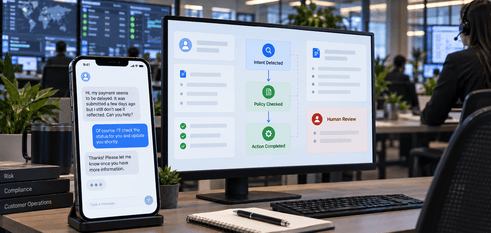
Cases involving material adjustments, uncertain counterparts, unusual account changes or missing evidence require review. Human approval controls should be enforced in the application layer, not requested politely inside an AI prompt. A reviewer must see the evidence and the proposed effect before approving anything.
Build an approval boundary that cannot be bypassed
For most finance teams, the safest arrangement is read-only access for retrieval and separate, restricted tools for any write operation. The agent may propose a correction, but it cannot directly invoke a posting function without an approved authorization token and validated business rules.
A strong maker-checker workflow also prevents the same person or service from both proposing and approving sensitive changes. The application records who initiated a case, which system created the suggestion, who approved it and what was ultimately changed. Permission checks must apply to API calls as well as buttons in the user interface.
The New York State Department of Financial Services maintains a cybersecurity regulation resource centre for entities subject to its requirements. Those requirements are not automatically applicable to every business operating in New York, but they illustrate why access governance and system controls matter when financial data is involved.
Finance and security leaders should decide which steps can be fully automated and which demand review. A low-risk correction to a descriptive tag may follow a different workflow from a write-off, supplier bank-detail change or release of a payment. Approval should depend on the action's effect, not on whether the AI system labels it routine.
What happens when an exception reaches the queue?
Consider a settlement with an amount difference. The system first verifies that the bank record and processor report refer to the same merchant and settlement period. It checks known deductions, pending refunds and whether another payout contains the remaining balance.
If the difference is explained by an expected processing fee, the rules engine can classify the case and show the calculation. If the evidence is incomplete, the agent creates an exception packet with the source documents, candidate matches, unresolved questions and suggested owner. The analyst can accept the explanation, request another record or reject the suggestion.
This approach makes reconciliation exception management more useful than a dashboard showing only unmatched totals. Each exception has a state, owner, supporting evidence and age. A case should not disappear from the queue merely because the model generated a plausible answer.
When a reviewer authorizes a posting, the application records the approved change and the response from the destination system. Failed API calls require clear retry controls. A network timeout must not trigger a second journal entry or payment request without checking whether the first command succeeded.
Design auditability before increasing automation
An auditor or finance manager should be able to reconstruct the entire case. That means preserving the original source record, rules applied, model-generated explanation, relevant prompt or tool version, human decision and final system action. Audit trail for AI workflows is a functional requirement, not an optional reporting feature.
When an agent changes, the team must still explain earlier recommendations using the policy and evidence available then. Protect sensitive logs according to applicable obligations.
For a firm evaluating an AI development company in New York, it is worth asking how its proposed agent tools enforce permissions, handle rejected suggestions and prevent duplicate writes. Attractive demonstrations often avoid these details even though they determine whether the system is operationally safe.
Protect financial information across connected systems
An agent should use least-privilege credentials and access only the records necessary for its assigned task. Separate environments for development and production, encrypt data in transit and at rest, and avoid exposing account numbers or personal details in ordinary model prompts when redacted references will do.
Role-based access control should distinguish analysts, approvers, administrators and auditors. Approval rights may also depend on business unit, transaction category or financial threshold. A model must not grant itself wider access by interpreting an email or attachment as an instruction to change credentials.
External documents are untrusted inputs. A merchant message can describe a dispute, but it should never control the agent's tool permissions. The application should validate extracted fields and treat unexpected requests as data to review, not commands to execute.
These requirements shape architecture choices. Custom fintech software development may connect existing ledgers, payments and case management rather than replacing them. A controlled API layer is often more important than a sophisticated conversational interface.
Measure quality before allowing more autonomy
Start in observation mode. Let the platform produce matches and recommendations while finance staff follow the existing reconciliation process. Compare confirmed matches, false matches, unresolved exceptions, analyst effort and the time needed to gather evidence. A higher automatic match rate is not an improvement if incorrect matches increase.
Next, permit low-risk classifications with safeguards. Test missing data, reversed transactions, duplicate reports, changes to settlement cutoffs and conflicting evidence. Review examples from each failure category rather than judging performance only by an average accuracy score.
A phased rollout should include a way to stop automated writes immediately. Assign ownership for model monitoring, policy changes, incident handling and daily exception review. Staff need a straightforward way to report an incorrect suggestion and find the original evidence.
The combination of approved integrations and cloud consulting services can support secure processing and monitoring, but cloud deployment does not itself provide segregation of duties, correct accounting treatment or regulatory compliance. Those must be designed and tested.
Frequently asked questions
Can an AI agent reconcile bank transactions automatically?
It can retrieve records, apply matching rules and recommend resolutions. Whether it may post final adjustments depends on the organization's controls, the nature of the change and required authorization.
Is agentic AI different from robotic process automation?
RPA generally follows predefined steps. Agentic software can choose among permitted tools to investigate an exception, but dependable reconciliation still needs deterministic checks, constrained access and clear approval boundaries.
Should every reconciliation difference go to a human?
Not necessarily. Clearly explained, low-risk matches can follow approved automatic rules. Ambiguous records, material adjustments and sensitive write operations should be routed according to a documented risk policy.
How do finance teams prevent duplicate postings?
Use transaction-level identifiers, idempotency keys where supported, confirmation checks after API calls and approval records tied to the exact proposed change.
From matched records to approved results
The useful outcome is not an autonomous agent that closes everything. It is a finance workflow that gathers evidence quickly, explains mismatches and lets authorized employees approve consequential changes.
Theta Technolabs develops custom Agentic AI solutions for finance operations using AI agents, secure API integrations and workflow automation to help businesses in New York streamline reconciliation, investigate transaction discrepancies and manage approval processes with proper human oversight. To discuss your finance automation software requirements, contact us at sales@thetatechnolabs.com.